
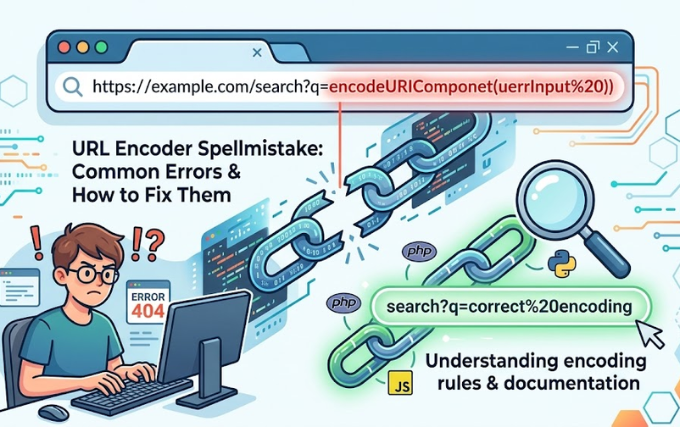

A small typing error can break a whole web link. Many developers and beginners face issues when they work with URL encoding. The term url encoder spellmistake describes mistakes that happen during encoding or when people type encoding-related terms incorrectly. These mistakes often lead to broken links, failed requests, or unexpected results.
To begin with, URL encoding changes special characters into a format that browsers understand. However, even a minor spelling error in the encoding process can disrupt communication between browser and server. As a result, users may see errors instead of the expected page.
Moreover, people often misunderstand encoding rules and type incorrect function names or parameters. Therefore, confusion increases when debugging starts. In addition, different programming languages use slightly different encoding functions, which creates more room for mistakes.
For example, a missing symbol or wrong letter can change how a browser reads a URL. Consequently, developers spend extra time fixing issues that come from simple typing errors. Meanwhile, beginners struggle more because they do not fully understand encoding structure.
Understanding URL Encoding Clearly
URL encoding helps convert unsafe characters into safe ones for web transmission. For instance, spaces turn into “%20” so browsers can read them properly. Developers rely on this process to send data through URLs without errors.
However, confusion often begins when people miswrite encoding functions or confuse syntax rules. Therefore, even a small mistake changes the output completely. In addition, encoding requires strict attention to detail because browsers do not forgive errors easily.
Moreover, each programming environment offers its own encoding tools. JavaScript, Python, and PHP all provide different methods. Consequently, users sometimes mix function names and create errors without realizing it.
For example, a developer might type “encodeURIComponet” instead of “encodeURIComponent”. As a result, the program fails or returns unexpected output. Meanwhile, debugging takes longer because the issue looks small but causes major disruption.
Common url encoder spellmistake Problems
Many errors appear repeatedly in coding environments. These mistakes often come from typing, misunderstanding, or copying incorrect syntax.
1. Misspelled Function Names
Developers often misspell encoding functions. For instance, they may write “URLEncode” incorrectly or forget letters in long function names. Consequently, the program throws errors or ignores the function completely.
Moreover, this issue happens more in fast-paced coding environments. Therefore, careful typing reduces this problem significantly.
2. Incorrect Case Usage
Programming languages care about uppercase and lowercase letters. Therefore, writing “urlencode” instead of “URLEncode” may break the code in some systems.
In addition, developers sometimes mix camel case and snake case styles. As a result, the function does not execute correctly.
3. Wrong Character Encoding Assumptions
Some developers assume encoding works the same everywhere. However, different systems handle characters differently. Consequently, this misunderstanding creates broken URLs or unreadable data.
Moreover, special characters like “&”, “?”, and “=” require careful handling. Otherwise, the URL structure breaks easily.
4. Copy-Paste Errors
Many developers copy code from online sources. However, hidden characters sometimes enter the code. Therefore, the encoding process fails unexpectedly.
In addition, copied code may include outdated functions. As a result, compatibility issues arise during execution.
5. Missing Encoding Step
Some developers forget to apply encoding at all. Consequently, raw URLs contain unsafe characters. This mistake often leads to broken links or server rejection.
Moreover, this error becomes more common in beginner projects.
Why url encoder spellmistake Happens
Several reasons contribute to these errors. Understanding them helps prevent future problems.
Firstly, lack of attention leads to typing mistakes. Developers often rush through code and miss small details.
Secondly, limited experience with encoding rules creates confusion. Therefore, beginners struggle to remember correct syntax.
Thirdly, inconsistent documentation across platforms increases misunderstanding. As a result, developers mix different standards.
In addition, fatigue plays a major role. Long coding sessions reduce focus and increase typing errors.
Moreover, switching between programming languages causes memory confusion. Therefore, developers may apply wrong syntax from another language.
Real Examples of Encoding Mistakes
Consider a simple URL like:
https://example.com/search?name=John Doe
Without encoding, the space breaks the URL. Therefore, encoding converts it to:
John%20Doe
However, if a developer writes the function incorrectly, the result fails. For example, using a wrong function name produces no output.
In another case, missing encoding for special characters like “&” causes query splitting. Consequently, the server reads incorrect parameters.
Moreover, incorrect encoding of symbols may redirect users to wrong pages.
How to Fix url encoder spellmistake Issues
Fixing these errors requires careful attention and simple habits.
1. Double Check Function Names
Always verify spelling before running code. Therefore, careful checking eliminates small mistakes early.
Moreover, using autocomplete tools reduces typing errors significantly.
2. Follow Language Documentation
Each language provides official encoding functions. Consequently, reading documentation helps avoid confusion.
In addition, developers gain clarity about correct usage patterns.
3. Use Code Editors with Suggestions
Modern editors highlight spelling errors instantly. Therefore, developers can fix issues before execution.
Moreover, these tools reduce debugging time significantly.
4. Test URLs Step by Step
Break down encoding tasks into smaller parts. As a result, errors become easier to identify.
In addition, testing each step ensures accuracy.
5. Avoid Manual Encoding When Possible
Automatic encoding functions reduce human error. Therefore, developers should rely on built-in tools.
Moreover, automation improves consistency across projects.
Best Practices to Avoid Encoding Errors
Following good habits reduces mistakes significantly.
Firstly, always validate URLs before deployment. Therefore, broken links never reach users.
Secondly, maintain consistent coding style across projects. As a result, confusion decreases.
Thirdly, keep reference notes for encoding functions. Moreover, quick access to syntax improves accuracy.
In addition, practice writing encoding functions regularly. Therefore, memory improves over time.
Furthermore, review code with peers when possible. Consequently, careful review identifies errors early.
Tools That Help Prevent Errors
Many tools support developers in avoiding encoding issues.
Code editors like Visual Studio Code highlight syntax errors instantly. Therefore, developers fix mistakes quickly.
Online URL encoding tools also help verify results. Moreover, they allow quick testing without writing full programs.
In addition, debugging tools in browsers show URL issues clearly. Consequently, developers identify problems faster.
Troubleshooting Encoding Problems
When errors appear, follow a structured approach.
First, check spelling of all encoding functions. Therefore, careful checking eliminates simple mistakes early.
Next, review input strings for special characters. Moreover, ensure proper formatting before encoding.
Then, test output in different browsers. As a result, compatibility issues become visible.
Finally, compare expected and actual results. Consequently, debugging becomes more efficient.
Conclusion
The url encoder spellmistake issue may look small, but it creates major problems in web development. However, careful attention, proper tools, and consistent practice reduce these errors significantly.
Moreover, understanding encoding rules helps developers build reliable applications. Therefore, learning correct methods improves both speed and accuracy.
In addition, avoiding rushed typing and using automation tools ensures smoother workflows. Consequently, developers spend less time debugging and more time building features.
Ultimately, small improvements in spelling accuracy and encoding knowledge create stronger and more stable web systems.


