
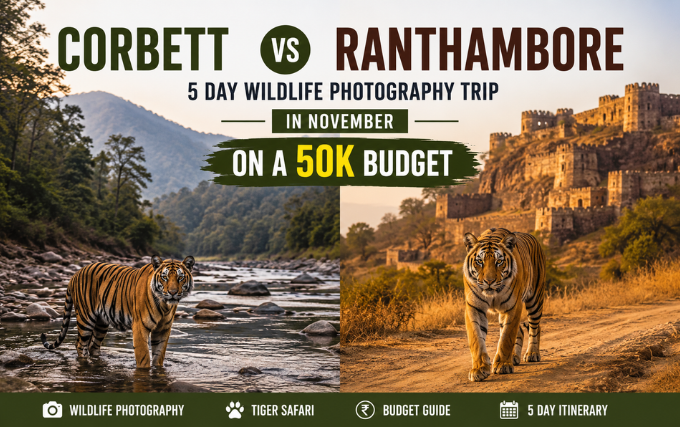

Planning a wildlife photography trip demands smart choices. Budget, season, and location shape the entire experience. November brings ideal conditions for forest photography in India. However, choosing between two famous parks creates confusion for many travelers. This article explains everything clearly and simply.
The focus here stays on compare corbett and ranthambore for a 5 day wildlife photography trip in november on a 50k budget. You will understand costs, experiences, travel, and photography value. Additionally, you will see which park fits better within a tight budget.
Understanding Both Wildlife Destinations
Jim Corbett National Park lies in Uttarakhand. It features dense forests, river belts, and mountain foothills. Tigers live here, yet spotting them feels challenging due to thick vegetation. However, birdlife and landscapes create strong photography opportunities.
Ranthambore National Park sits in Rajasthan. It offers open grasslands, dry forests, and ancient ruins. Tigers appear more frequently here during daytime sightings. Consequently, photographers often prefer Ranthambore for clear wildlife shots.
Both parks deliver unique experiences. However, they differ in terrain, accessibility, and wildlife visibility.
November Wildlife Conditions in Both Parks
November marks the beginning of peak safari season. Weather stays pleasant and dry in both regions. Consequently, animal movement increases near water sources.
In Corbett, forests remain lush after monsoon. Visibility reduces slightly due to thick vegetation. However, misty mornings create dramatic photography scenes. Wildlife behaves actively near riverbanks.
In contrast, Ranthambore dries out earlier. Grasslands open up for better sightlines. Tigers move freely during daylight hours. Therefore, photographers gain higher chances of capturing action shots.
Additionally, November avoids extreme heat and heavy rain. This improves both travel comfort and camera performance.
Budget Reality: 50K for 5 Days
A 50,000 INR budget demands careful planning. You must balance travel, stay, safaris, and food.
Here is a simple breakdown:
- Safari permits and gypsy rides: 18,000–24,000
- Accommodation (budget stays): 10,000–14,000
- Travel (train or shared transport): 8,000–12,000
- Food and extras: 6,000–8,000
Therefore, both destinations remain possible within this budget. However, Ranthambore often offers slightly cheaper logistics due to better connectivity.
Additionally, booking early reduces costs significantly.
Travel Accessibility Comparison
Corbett requires travel to Ramnagar. You can reach via train from Delhi or nearby cities. However, final forest zones sit deeper inside hills. Therefore, local transport adds extra cost.
Ranthambore connects through Sawai Madhopur railway station. Trains from Delhi, Jaipur, and Mumbai run frequently. Consequently, travel feels easier and cheaper.
Moreover, Ranthambore offers shorter transfers to park gates. Corbett sometimes demands longer jeep rides.
Thus, travel logistics favor Ranthambore for budget travelers.
Accommodation Experience
Corbett offers forest lodges, homestays, and eco-resorts. Prices vary widely near Jhirna, Dhikala, and Bijrani zones. However, budget options often sit farther from safari gates.
Rooms near Corbett may feel rustic but scenic. You wake up close to nature. Additionally, bird calls enhance morning experiences.
Ranthambore provides more structured budget hotels in Sawai Madhopur. Many guesthouses cater specifically to photographers. Therefore, you find better deals under 2,500 INR per night.
Moreover, food options feel more accessible in Ranthambore town. Corbett stays feel more remote.
Safari Experience Comparison
Corbett safaris feel adventurous and unpredictable. Dense forest reduces long-distance visibility. Consequently, spotting tigers requires patience and luck.
However, Corbett excels in biodiversity. You may photograph elephants, deer, crocodiles, and rare birds. Additionally, river scenes enhance storytelling shots.
Ranthambore offers a different thrill. Open terrain increases tiger visibility. You often witness tigers walking across roads or near lakes.
Moreover, Ranthambore allows clearer compositions for wildlife photography. Background clutter remains minimal.
Therefore, Ranthambore suits action-focused photographers. Corbett suits nature storytelling enthusiasts.
Photography Opportunities
Corbett challenges your patience and framing skills. You must adapt to shadows, fog, and dense foliage. However, this creates artistic images with depth.
Bird photography shines strongly in Corbett. You may capture kingfishers, hornbills, and eagles. Additionally, rivers and mist improve landscape shots.
Ranthambore delivers high-impact wildlife images. Tigers often appear in golden light. Consequently, you capture dramatic portraits easily.
Furthermore, ruins inside Ranthambore add cinematic backgrounds. These elements increase storytelling value.
If you plan compare corbett and ranthambore for a 5 day wildlife photography trip in november on a 50k budget, photography style becomes the deciding factor.
Cost Efficiency and Value
Corbett may increase costs due to remote zones and transport. Safari zones like Dhikala require forest rest house bookings. These bookings often sell out quickly.
However, Corbett rewards you with variety and natural scenes. You invest effort rather than convenience.
Ranthambore reduces logistical stress. You manage bookings and movement easily. Consequently, you save both time and money.
Additionally, Ranthambore allows more safaris within budget. This increases chances of tiger sightings.
5-Day Itinerary Suggestion
A structured plan improves your photography output.
Day 1: Arrival
Reach Sawai Madhopur or Ramnagar. Settle into accommodation. Explore nearby areas for light scouting.
Day 2: First Safari
Take morning safari. Focus on learning terrain and animal patterns. Additionally, adjust camera settings.
Day 3: Double Safari Day
Book both morning and evening safaris. Increase chances of wildlife sightings. Review images in between sessions.
Day 4: Prime Photography Day
Focus on high-priority zones. Track animal movement patterns. Moreover, experiment with compositions.
Day 5: Final Safari and Return
Capture final shots early morning. Then prepare for return journey.
This structure works for both parks. However, Ranthambore maximizes sightings within limited safaris.
Which Park Fits Better for 50K Budget?
Both parks offer value, yet outcomes differ.
Corbett delivers raw wilderness and diverse wildlife. However, costs and uncertainty increase slightly. Dense forest also limits clear tiger photography.
Ranthambore provides higher tiger visibility. Travel stays simpler and cheaper. Additionally, accommodation fits tighter budgets easily.
Therefore, Ranthambore suits most photographers under strict budgets.
However, Corbett suits those who prefer artistic forest storytelling.
Conclusion
Wildlife photography depends on expectations and style. November enhances both destinations with ideal weather. However, terrain and accessibility shape your final experience.
If your priority focuses on tiger photography and budget control, Ranthambore delivers stronger results. Meanwhile, Corbett rewards patience and creativity.
Ultimately, your success depends on planning and timing. With smart preparation, both parks create unforgettable wildlife memories.


